Imagine you're starving and someone walks in with a pizza. You're not thinking about calories — you're grabbing a slice. Now imagine you've just had a full curry. That same pizza? Not interested. People work the same way online. When thousands of people start searching for the same thing at the same time, that is a YouTube trending moment. And if you know how to spot YouTube trending topics early, you can grow your channel faster than almost anything else you will ever do.
This article shows you exactly how to do that using Hype Trends, the tool built for creators who are tired of chasing trends after they have already peaked.
Why YouTube Trending Content Changes the Game
Most YouTube creators focus exclusively on evergreen content — videos on topics that collect steady views month after month. That strategy works. A well-optimised evergreen video might bring in a hundred views a day, consistently, for years. That slow build is the foundation of a serious channel.
But trending YouTube videos play an entirely different game. When you publish content on a topic that is surging right now — before the wave crests — you can generate more views in a single week than your evergreen videos get in a year. Those views bring new subscribers. Those subscribers watch your other videos. The algorithm takes notice. A single trending video can act like a lever that lifts everything else on your channel.
The downside is real: trending topics cool off. What's hot today may be irrelevant by next Friday. That is why timing is everything. The creators who win are not the ones who make the best videos about a trend — they are the ones who made good enough videos first.
Trending vs Evergreen: You Need Both
Think of your content strategy as a portfolio.
Evergreen Content: Your Steady Foundation
Evergreen videos rank for searches that exist today, tomorrow, and five years from now. "How to set up a home studio" will always get searched. These are your long-term assets — they do not spike, but they never stop working either. According to Statista, YouTube has over 2.7 billion monthly active users — evergreen content taps a fraction of that permanently.
The catch: evergreen topics attract fierce competition. Ranking for them takes time, watch-time authority, and consistent volume. A newer channel competing for established evergreen keywords is fighting creators with years of algorithmic momentum behind them.
Trending Content: Your Growth Accelerator
Trending content brings bursts of new traffic, introduces you to audiences who would never have found your evergreen content, and signals to the algorithm that your channel is relevant right now. Even short-lived trends — ones that only stay hot for two weeks — create subscriber and suggested-video ripple effects that last months.
The mistake most creators make is only building one side. All evergreen means slow, steady, and safe — but growth is painfully gradual. All trending means exhausting, unpredictable, and ultimately hollow because you never build a loyal base.
The winning formula: use trends to grow the audience, use evergreen to hold it.
What's Wrong with Just Using Google Trends for YouTube
Google Trends is a free, well-known tool that shows search interest over time. Many YouTube creators use it to research video topics, and it is genuinely useful — as far as it goes. But it has real limitations for creators who need to move fast:
- It shows Google search data, not YouTube search data. The two audiences behave differently. A topic trending on Google may not be trending on YouTube at all. You have to manually switch the source from "Web Search" to "YouTube Search," and even then the data is broad and slow to update.
- It does not surface breakout topics automatically. To find what is emerging, you have to already have a guess about what to look up. Google Trends tells you how a term is performing — it does not tell you which terms are exploding right now.
- It was built for advertisers, not creators. The interface requires significant manual work — tab-switching, side-by-side comparisons, educated guessing — before you can draw any conclusion about what to film next.
According to Sprout Social's Social Media Trends Report, speed of response to emerging trends is one of the most cited competitive advantages among high-growth content creators. A tool that requires significant manual research to surface opportunities is a tool that makes you slower — not faster.
How to Find YouTube Trending Topics with Hype
Hype Trends works differently. You do not need to know what to search for — Hype shows you what is already gaining traction on YouTube, ranked by real engagement data, so the discovery is proactive rather than reactive. Here is the full workflow.
Step 1 — Choose Your Category
Hype organizes trending topics into nine YouTube content categories:
- Science & Technology
- How To & Style
- Education
- Entertainment
- Gaming
- Travel & Events
- News & Politics
- People & Blogs
- Sports
Start with the category that matches your channel. This filters results to topics relevant to your actual audience — not global trending noise from unrelated verticals. Over time, also check adjacent categories. Some of the highest-opportunity trends start in a neighbouring vertical before crossing into yours — and that crossover window is often the best moment to create.
Step 2 — Set the Time Range
Hype offers four time ranges. Choosing the right one depends on your production speed:
- 2 days — breaking trends, lowest competition, shortest window. Only use this if you can publish within 24–48 hours.
- 7 days — the best default for most creators. A week of sustained momentum signals a real opportunity, not a one-day anomaly.
- 30 days — sustained trends with proven demand. Strong signal for keywords worth building evergreen content around.
- 60 days — durability filter. What has held momentum over two months has long-term keyword value.
Step 3 — Pick a Scoring Mode
Hype ranks trending topics by three scoring modes:
- Views — ranks by raw viewership. Best for maximum traffic potential.
- Balanced — combines views, likes, and comments. Best default for most searches.
- Comments — ranks by comment activity relative to views. Best for finding topics with strong emotional resonance where discussion will drive your video's performance.
Step 4 — Open a Trend for Full Detail
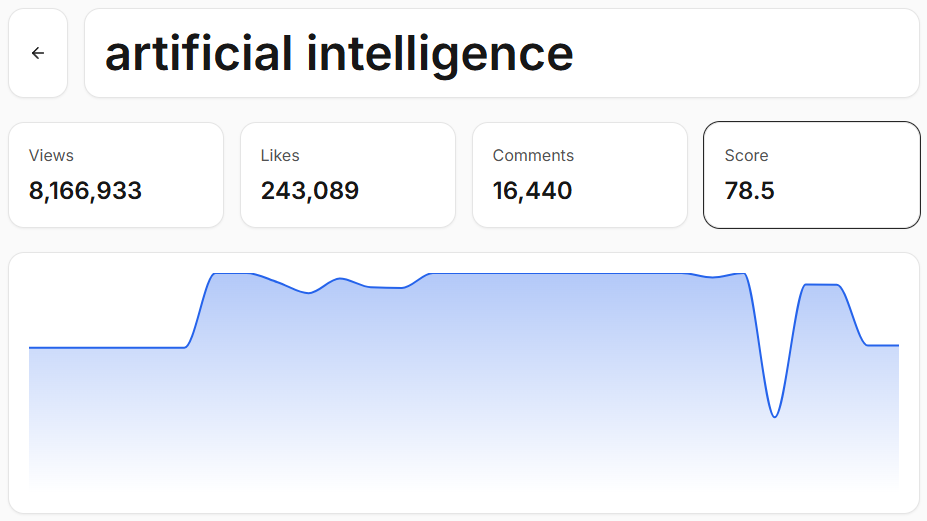
Clicking any trend opens its full detail view — this is where Hype goes beyond a keyword list:
- Summary — what the trend is about and why it is gaining momentum right now.
- Score chart — a time-series graph of the trend's engagement over the selected period.
- Source videos — the actual YouTube videos generating this trend's performance, showing you the exact format and title structure already working.
- Linked trends — related topics trending alongside the one you opened, where breakout sub-opportunities hide.
How to Read the Trend Score Chart
The score chart shows relative engagement over time built from actual YouTube data. The pattern you are looking for is a rising slope that has not yet peaked — steady upward movement with no sign of reversal means you are still ahead of the saturation point.
Watch out for these three patterns:
- Spike then flat — a one-time event drove the numbers. The topic may have already peaked. Validate with the 30-day view before committing.
- Consistent plateau — stable for weeks. Lower urgency, but reliable. Good candidate for an evergreen-style video.
- Sharp upward curve in the last 2–3 days — act immediately. This is the breakout phase. The window is still open.
Use Hype's Content Lens alongside the score chart to understand which format and hook structure is performing in the source videos. The chart tells you the topic is worth pursuing; Content Lens tells you the format that will perform.
Using Linked Trends to Find Breakout Topics
The linked trends panel is one of Hype's most underused features — and often the best place to find your next video topic. When a major trend gains traction, a cluster of related sub-topics rises alongside it. These linked trends typically have less competition than the primary trend because fewer creators have noticed them yet.
Open a top-performing trend in your category, switch to the Linked Trends tab, and look for topics that are:
- Specific enough to make a focused video — not too broad
- Thin on competition — search the phrase directly on YouTube and check how many videos exist and how recent they are
- Rising faster than the primary trend — these are the breakout sub-topics most creators will discover a week from now
Turning a Trending Topic Into a Video That Ranks
Finding a trending YouTube topic is only half the work. Turning it into a video that captures that traffic requires basic YouTube SEO. A few things that matter most:
- Put the trending keyword in your title, early. YouTube's algorithm uses your title as the primary signal for what your video is about. If people are searching a specific phrase, your title needs to reflect it naturally and near the front.
- Write a description that includes the keyword and related terms. Your description is indexed by YouTube. Use the first two sentences to summarise the video and include your primary trending keyword.
- Thumbnail clarity wins. Trending topics attract a flood of uploads. Your thumbnail needs to communicate the topic instantly — bold text, a clear visual, and strong contrast matter more than creativity when viewers are scrolling fast.
- Publish at the right moment. Trending content has a brief window where the algorithm is most likely to push it into suggested feeds. Upload when your audience is most active — typically mid-week evenings and weekend mornings in your target region.
When Hype surfaces a trending topic, the topic name reflects exactly how real viewers are phrasing it on the platform right now. Use that exact phrasing in your title, description, and spoken hook. The trend name is the keyword — do not paraphrase it. Then use Hype's AI Rulebook to validate your content approach against your brand rules before you publish, so you stay consistent even when moving fast.