

YouTube ranking connects viewers with videos that match their interests, searches, and viewing habits. Search results emphasize relevance, engagement, and quality, while recommendations also respond to each viewer’s preferences. Understanding these differences helps creators make better decisions about topics, packaging, and content—not chase a single algorithm trick. (support.google.com)
How does YouTube ranking work?
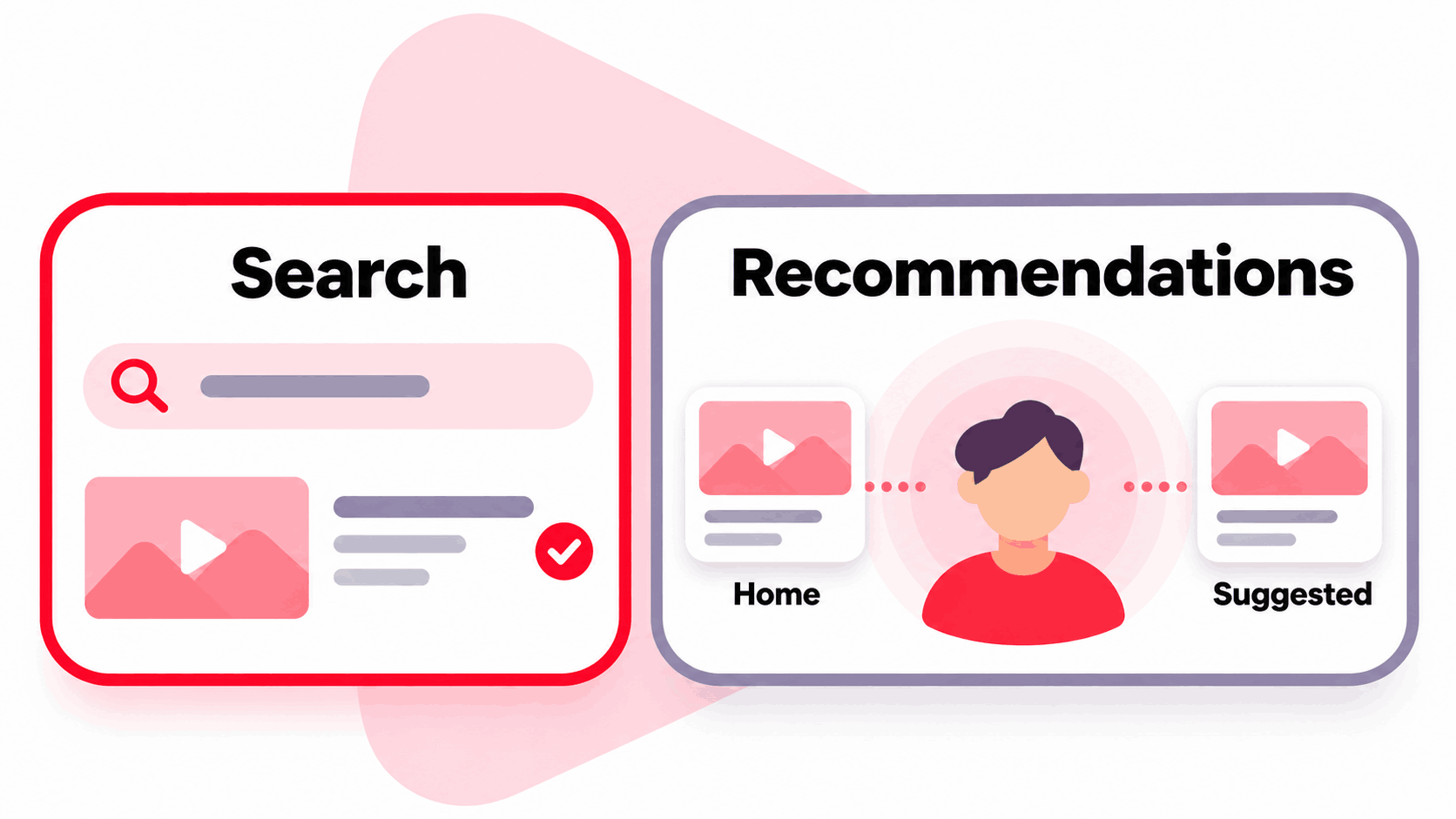
YouTube ranking works differently depending on where someone discovers a video. Search evaluates how well content answers a query; Home recommends videos for individual viewers; Suggested identifies videos they may want to watch next. Across these surfaces, YouTube considers relevance and viewer response rather than simply sorting videos by total views. (support.google.com)
That distinction matters when setting goals. A searchable tutorial and an entertaining documentary can both succeed, but they serve different viewing situations. Before optimizing an upload, decide whether your primary aim is answering an existing question or attracting someone who was not actively looking for your topic. Use that choice to guide the title, opening, and scope.
Search responds to a specific need
YouTube Search considers how closely the title, description, tags, and video content match a query. It also evaluates engagement associated with that search, including watch time, and signals of expertise, authoritativeness, and trustworthiness. Search history and watch history can personalize results, so two people may see different search rankings for the same phrase. (support.google.com)
For example, imagine someone searching for “beginner guitar tuning.” Build that video around tuning instructions a beginner can follow. A broad history of the guitar would be a poor editorial fit for that specific need, even if it were beautifully produced.
Home and Suggested anticipate interest
Home recommendations draw on a viewer’s history and how videos have interested and satisfied similar viewers. Suggested videos often relate to the video currently playing, although viewing history can also influence them. These placements are personalized opportunities, not fixed positions that every viewer sees. (support.google.com)
Which YouTube ranking factors matter most?
The most useful YouTube ranking factors to understand are relevance, viewer choice, engagement, and satisfaction. Their role depends on the discovery surface and format: Search needs to answer a query, while recommendations predict what someone will want to watch and enjoy. Treat these as connected signals, not an optimization checklist with guaranteed weights. (support.google.com)
Appeal earns the viewing decision
YouTube describes appeal as whether people choose to watch content, ignore it, or indicate that they are not interested. Your topic, title, and thumbnail should therefore communicate a recognizable reason to watch. Make the promise specific enough that the intended viewer can quickly judge whether it is relevant. (support.google.com)
Try pairing a clear outcome with a useful constraint. For a hypothetical cooking video, “Three Dinners Using One Pot” gives you a concrete promise to fulfill. Avoid adding urgency or dramatic claims that the actual video cannot support.
Engagement shows whether viewers stay
YouTube uses average view duration and average percentage viewed as ranking signals. Neither means every upload should be longer: the practical goal is sustaining attention for the time your subject genuinely requires. Build around useful demonstrations, clear explanations, or a compelling story rather than stretching the runtime. (support.google.com)
As an editing exercise, review each segment and ask what the viewer gains from it. Keep necessary context, but challenge repeated introductions, lengthy setup, and examples that make the same point. For a tutorial, consider showing the finished result before explaining the process.
Satisfaction goes beyond watch time
YouTube also uses signals such as likes and post-watch surveys to understand whether viewers enjoyed a video. That means watch time alone is not a complete explanation of video ranking. A useful working principle is to deliver the experience your packaging promised, rather than relying on curiosity that the content never resolves. (support.google.com)
Research YouTube ideas with n8n
Use the Hype n8n workflow to collect gaming trend data and build a shortlist for your next video.
Explore the n8n research guideBuild a repeatable process for ranking YouTube videos
A practical approach to ranking YouTube videos starts before upload. Use the following workflow to connect a viewer need with a clear promise and a complete answer. Treat it as an editorial process to test, not a formula that guarantees distribution.
- Define one intended viewer. Write down their starting knowledge, immediate problem, and desired outcome. “A first-time gardener growing herbs indoors” is a more actionable brief than “people interested in plants.”
- Choose one primary intent. Decide whether the video will explain, demonstrate, compare, or entertain. If the concept tries to do everything, narrow it before recording.
- Draft the packaging early. Write a working title and sketch a thumbnail. Use them to check whether the idea has a clear promise, then revise both to match the finished video accurately.
- Deliver value promptly. Establish what viewers will get and begin fulfilling that promise. For a demonstration, show the task; for an explanation, state the central answer before developing it.
- Review the viewing experience. Remove avoidable repetition, verify important details, and check that each example advances the main purpose. Ask whether a newcomer could follow without missing context.
For search-focused uploads, use the main topic naturally in the title and description, and ensure the video actually addresses it. These elements help YouTube assess relevance; repeating the same phrase does not substitute for a useful answer. Keep descriptions readable rather than turning them into keyword inventories. (support.google.com)
Do not let tags absorb most of your optimization time. YouTube says tags play a minimal discovery role except when they help with commonly misspelled terms. Its guidance places greater importance on the title, thumbnail, and description. (support.google.com)
Read analytics as a diagnosis, not a scorecard
YouTube Studio separates discovery sources such as Search, browse features, and Suggested videos. Start there before comparing performance, because a blended total can conceal very different viewing contexts. Review comparable uploads and traffic sources rather than assuming every video should produce the same pattern. (support.google.com)
Use this diagnostic checklist to choose your next investigation:
- Impressions grow while click-through rate falls: Check whether the video is reaching beyond your core audience. YouTube notes that broader distribution can lower CTR, so the decline alone does not establish that your packaging failed. (support.google.com)
- Viewers leave during the opening: Compare the introduction with the title and thumbnail promise. Consider whether the opening needs a faster demonstration, clearer context, or a more accurate expectation. (support.google.com)
- A segment shows a retention spike: Watch it closely before celebrating. Spikes can reflect rewatching or sharing, but they can also indicate confusion that required another viewing. (support.google.com)
- Strong metrics do not produce more impressions: Consider topic demand, competing videos, and seasonality. YouTube identifies all three as external influences on reach. (support.google.com)
For your next experiment, record one hypothesis and one change. You might test a clearer title or move a useful demonstration earlier in a future upload. This creates a more interpretable learning process than changing the topic, packaging, structure, and format simultaneously.
Put channel growth and common shortcuts in perspective
Think of YouTube channel ranking as a shorthand for visibility, not one universal leaderboard. YouTube’s recommendations use fresh performance data for individual videos, and one unsuccessful experiment does not necessarily limit future uploads. However, repeatedly publishing content that fails to resonate can affect overall channel performance. (support.google.com)
Build continuity by planning genuinely related videos. A beginner lesson could lead to a practice routine, then a troubleshooting demonstration. YouTube recommends series, playlists, and end screens as ways to help viewers discover more of your content; use them when the next video offers a logical continuation. (support.google.com)
Be equally cautious with scheduling shortcuts. YouTube says daily uploads are not required, and publish time is not known to determine long-term performance. Choose a sustainable production rhythm rather than sacrificing useful content to meet an arbitrary frequency target. (support.google.com)
Changing a title or thumbnail is not an automatic ranking reset, either. Any performance change reflects how viewers respond differently to the new packaging, rather than the edit itself earning a boost. Revise with a clear purpose: make the promise easier to understand or more faithful to the video. (support.google.com)
Make the next video easier to choose and worth finishing
The YouTube algorithm is best approached through audience understanding: what viewers want, what they choose, and whether they enjoy the result. Search optimization and compelling packaging support that goal, but neither replaces the content itself. (support.google.com)
For your next upload, choose one viewer need, make one accurate promise, and deliver it without unnecessary detours. Then use the evidence from that video to decide what to improve next.
Build a YouTube idea shortlist with n8n
Follow the Hype n8n workflow to collect gaming trend data and turn a topic into a video idea.
Explore the n8n research guide